
You are Very Important (notes on the Sixth Day of Creation)

Human beings in the West are very confused.
On the one hand we sense that we are important and significant. Life means something. We have purpose: a high purpose. We were destined for great things.
On the other hand we tell ourselves, incessantly, that we are meaningless and insignificant:
“Earth is a tiny planet in a tiny solar system in a galaxy that is just one of countless billions. The apparent significance of our planet is an illusion.
“And human beings are simply one life-form among millions. Our sense of being more important than other life is an illusion. The apparent difference between Melinda and malaria, Timothy and tapeworms, Bob and bacteria, is a trick: a trick born of our pathetic tendency to self-aggrandisement and the pernicious influence of religion.
“Anyway, what we call “life” is merely a composite of chemical reactions and discharged electricity. This may create the chimera of life and consciousness, but the chemical reactions in the brain are the same in kind as the chemical reactions in the fertiliser factory, and no different in objective value.”
We say that “the value of human life is illusory.” Yet when some regime or dictator acts consistently with this, and butchers whole populations of people who stand in the way of their grand designs, it shakes and sickens us to the core.
“The value of human life is illusory.” Yet at the mere sound of the word, Hiroshima, our souls shudder.
We are confused.
Our young men crave to lead and protect, yet give up their eyes and hearts to faecal sewers of pornography. Our young women yearn for love and respect, yet give their bodies to men who have made no public and honourable commitment to them, nor even a pretence of commitment.
Western ethics are shambolic. The same political party that pushes for liberal abortion laws pushes for harsh penalties for women who smoke while pregnant. The same leaders who cry for legalised prostitution—to open the brothel doors to our sisters and daughters, and to smooth the way for sex traffickers—are the most shrill when sexual harassment strikes.
Our hearts tell us that we are important. Our heads tell us that this is an illusion. We are confused, and the confusion is shredding the Western soul.
What does God’s Word say? “Your heart’s instinct is right! Your head is wrong!” “You’re not thinking right!” “Listen to the truth about yourself; you’re more important than you could ever have conceived!”
Open up to Genesis 1:24-26, and you will see three reasons why you are important:
A. You are important because this world was made for you
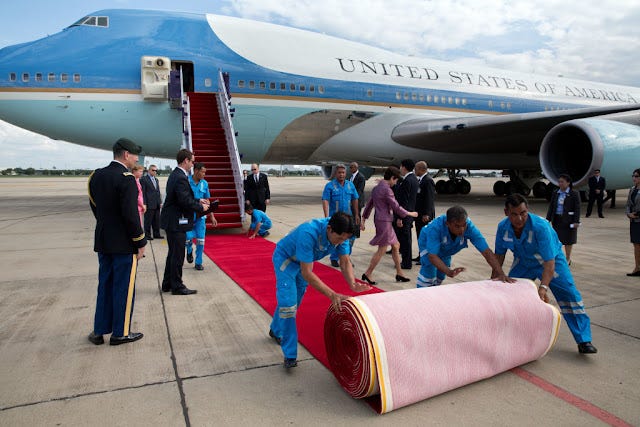
When the President of the United States visits another country, the preparation is stupendous. Teams of security experts meet with local law-enforcement to prepare to keep the President’s body safe. An armoured limousine is delivered: bullet, bomb, and rocket proof. The airport is closed. The host nation’s highest dignitaries stand waiting on the tarmac. A gleaming guard of honour stands to attention. A rich red carpet is unrolled, and a brass band plays. All of this preparation says: “This person is important.”
Compare this to God’s preparation for your arrival. Creation was at first lightless, lifeless, formless, and watery. You were on the way. (Remember at this point the Hebrew concept of corporate identity: Adam was the father of all human beings. All human beings are derived from him, and so all human beings were represented by him, and were latent in him. By preparing the world for Adam, God was very much preparing the world for you.)
God saw the darkness, he saw you coming, and he said “Let there be light!” And he flooded creation with physical light and the light of truth and goodness.
God saw the airless watery chaos, he saw you coming, and he said “Let there be a firmament, an expanse!” And he created breathing space for you, a place to respire.
God saw the seas, he saw you coming, and he said “Let the waters be gathered, and let dry land appear, and let the land be filled with seed bearing plants, and let it look beautiful!” And so he stocked a mighty pantry for you, and adorned your world with heart-aching beauty.
God said, “Let there be a sun, moon, and stars, to regulate the seasons and tides that humanity needs, and to call humanity to the greatest and most glorious and beautiful and satisfying thing a human being can do: to worship and enjoy me!”
God saw the empty skies and seas, and he saw you coming, and he said “Let the sky be filled with living creatures, birds of many kinds. And let the seas be filled with fishes and whales and other sea-creatures.” And so God adorned the skies and seas with creatures that give life, and enhance and beautify life.
“And God said, “Let the land produce living creatures according to their kinds: the livestock, the creatures that move along the ground, and the wild animals, each according to its kind.” And it was so. God made the wild animals according to their kinds, the livestock according to their kinds, and all the creatures that move along the ground according to their kinds. And God saw that it was good” (Gen 1:24-25).
Notice three kinds of animals for the land:
behemah, animals in general, and cattle in particular. (Not to be confused with behemoth, very large animals like the hippopotamus and crocodile.) In this context it probably refers to domestic animals like oxen, camels, cows, sheep, and goats. These were the “clean” animals that provided God’s people with milk, meat, leather, fertiliser, transport, and muscle power. (Later they would be used for sacrifices.)
remes, all manner of “unclean” mammals, amphibians, and reptiles: snakes and sloths, hares and hounds, goannas and geckos, frogs and field-mice, boars and bandicoots.
chaya eretz, animals of the earth, that creep along the ground, including insects.
Together these encompass all creatures great and small, that are indirectly or directly necessary for human life. Indirectly because the swarming animals are an essential part of the world’s ecosystem: every animal, no matter how minuscule, ugly, noxious or obnoxious, forms part of the essential food chain and circle of life. And directly because many animals, domestic animals in particular, serve humanity’s needs for transport, muscle-power, tools, clothing, and food. I remember, for example, when I lived in an aboriginal community, an elderly man skinning a kangaroo and showing that every part had a good use: even a claw which he used, with a mirthful smile, to comb his grey hair.
These animals were made “according to their kind.” Just as God didn’t make one all-purpose plant to feed humanity, but instead made numberless delightful varieties of fruits, vegetables, and grains, God did not provide one generic animal that would serve all our needs of food, transport, and labour. Instead God made a bewildering and enchanting variety of animal life. God declared these animals “good”: well-made and well-suited to the needs of human beings.
You are important because God did all this for you! He prepared this world for you.
B. You are important because God made you differently.
If there are many today who like to say that “Humans are just animals,” Genesis says loud and clear, “You are distinctly different!” It does this in three ways.
Notice first the “Let us make.” This is the first time God precedes his created work with this solemn preamble. Humanity will be made very differently to the rest of creation because God intended for us to be fundamentally different. How much these three words teach us about God! He is One (Deu 6:4), and He is a plurality of persons: “Let us make.” This is not the Nicene Creed, but it blazes a trail to it.
Notice next in Genesis 2:7, which details Genesis 1:26, that “the LORD God formed the man from the dust of the ground and breathed into his nostrils the breath of life, and the man became a living being.” What intimacy! We live because God breathed his breath of life from his “mouth” into our nostrils. And God didn’t just suscitate us. He animated, enlivened, infused and imbued us with His Spirit—with Himself!
Notice thirdly the jarring “bump in the text.” After making light, “It was good.” After the firmament, “It was good.” After the dry land and vegetation, “It was good.” After the heavenly lights, “It was good.” After the birds and fishes, “It was good.” After humanity... “God saw all that he had made, and it was very good!” Every Christian should love and respect the natural world: for God made it and it is good. And we should love and respect humanity all the more, for God has declared us very good.
Five words here about Genesis 1 and evolutionary theism: It does not teach it. It positively does not teach that God made humanity from animal species, and vegetable life before that, and lifeless compounds before that, through an infinitely lengthy and infinitesimally gradual step-by-step process of adaption. It is not taught in the lines, it is not implied between the lines. And theologically, everything that the Bible teaches about humanity contradicts it: especially with the links that it draws between us and Adam as our historic father and representative (Rom 5:12-21, 1Co 15:21-49), links that are simply nonsense if Adam was not the real first man created by God in Genesis 1 and 2, and the one original ancestor of us all.
God made you different to creation, to show that though you are part of creation, you are also distinctly important.
C. You are important because you bear God’s image.
“Let us make mankind in our image, in our likeness.” The word mankind, ādām, is closely related to the word adāmāh, meaning ground or soil. Humanity has continuity with the rest of creation: we are not God, but creatures of God. Yet note the untold dignity of these words.
Image (tselem, translated eikōn in the LXX, from which the word “icon” is derived) appears later in the OT as statue or model. E.g. “All the people of the land went to the temple of Baal. They smashed the altars and idols to pieces” (2Ki 11:18).
Likeness (demut, translated homoiōsis in the LXX) refers to a pattern, form, or shape. In 2 Kings 16:10 it describes the model of an Assyrian altar that wicked King Ahaz sent back to Jerusalem, to be turned into a full-scale replacement of the true altar in the Temple.
Some scholars wonder whether these two words, “image and likeness,” refer to two different ways by which humanity resembles God. Most however think that they work together, “image-likeness,” to define the affinity between God and humanity. To see a human being is to see an image of God, a likeness of God, a picture of God, a representation and representative of God.
Image-bearing is described functionally in the very next verse: Humanity will “rule over” the rest of creation. A viceroy, literally vice-king, represents the king and rules in the king’s place when the king is not there in person. To honour and obey the viceroy is to honour and obey the king. God’s image-bearers are his viceroys. (More is said about image-bearing in 1:27-28, and we will delve into that next week.)
Genesis 1:24-26 explains the profound sense of high destiny and purpose that is deeply imprinted on the heart and soul of every human being. It is not an illusion. It is the inevitable consequence of our special creation.
Yes the imago dei has been severely marred. We are like the Titanic, resting almost 4km down on the floor of the North Atlantic, broken, holed, and rusting: a faded wreck of the glorious original. But it is still the Titanic, and we are still image-bearers!
And God the Son has come, incarnate in the same human flesh as you and me. How great is human dignity if God the Son took on the full body and soul of human nature. How great that he died for image bearers, (he did not die for horses,) to restore the image in us.
Every Christian is inspired by this. This week I saw a relic of a man at a bus-stop: dishevelled, reeking, stooped liked a whipped dog, fumbling to light a cigarette, cursing loudly, angrily, and uncontrollably. He bears God’s image. To see this man is to see something of God. He is God’s representative, God’s viceroy, a lord over creation!
Like Christ we long to see the Titanic raised and repaired, and not only restored, but even improved from its showroom condition. He served image bearers by dying for them. And we will do the same. That is why we sacrifice ourselves to educate the ignorant, to emancipate the slaves, to visit those in prison, and to protect the weak. That is why we wage do-or-die war against self-indulgence, the might-is-right ethic, prostitution, abortion, and slavery in its pure and de facto forms. That is why we honour, protect, and help the disabled. That is why we abhor euthanasia: we are image bearers to be cared for to the end with skill and respect, not animals to be put down.
You feel important because you are. You bear the image of God and Christ is your brother. Recover the image in Christ. Emulate Christ, and love other image-bearers with sacrificial love.