
Fish Must Fish
Jesus makes disciples who make disciples; Matthew 4:18–22

Cruise liner or battleship? Rest home or fort? Resort or gymnasium? What is the Christian Church supposed to be?
Though our forebears rest rejoicing in heaven as the Church Triumphant, we yet labour and fight on earth for Christ as the Church Militant.
Jesus stamped this fact on his church – permanently, deeply – when he called his first followers whilst simultaneously calling them to call other followers to him.
Matthew 4
After his temptation and the imprisonment of John the Baptist Jesus withdrew to Israel’s northern region of Galilee. First to his hometown Nazareth, southwest of the Sea of Galilee, and then to the north-shore city of Capernaum.
Thus Jesus began his public ministry not in Jerusalem but on Israel’s far-northeast frontier where Jews and gentiles lived side by side. So he fulfilled Isaiah’s prophecy:
Land of Zebulun and land of Naphtali, the Way of the Sea, beyond the Jordan, Galilee of the Gentiles – the people living in darkness have seen a great light; on those living in the land of the shadow of death a light has dawned (Matthew 4:15–16; Isaiah 9:1–2).
The sun of Jesus’ ministry would dawn upon all who lived in death’s shadow. He preached to both Jews and gentiles, “Repent for the Kingdom of Heaven has come near!”
No sooner did Jesus begin this task than he commanded others to co-labour with him:
Matthew 4:18–22 As Jesus was walking beside the Sea of Galilee, he saw two brothers, Simon called Peter and his brother Andrew. They were casting a net into the lake, for they were fishermen.
‘Come, follow me,’ Jesus said, ‘and I will send you out to fish for people.’
At once they left their nets and followed him.
Going on from there, he saw two other brothers, James son of Zebedee and his brother John. They were in a boat with their father Zebedee, preparing their nets. Jesus called them, and immediately they left the boat and their father and followed him.
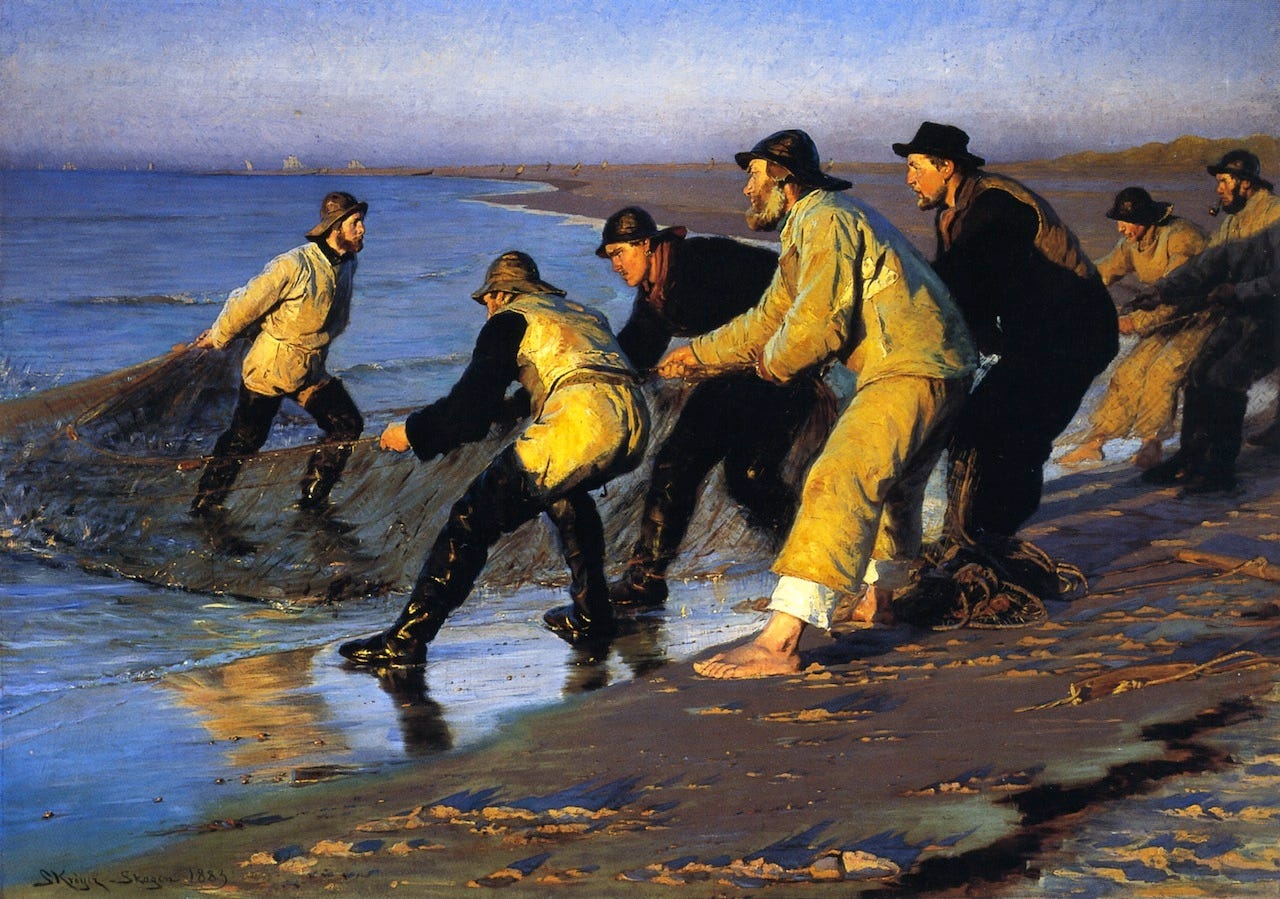
The first four people Jesus called to discipleship were fishermen. Jesus cast his net, caught them, and commanded them in turn to cast their nets for others.
Augustine muses that the “two ships out of which he had called his disciples” point to his mission to both Jews and gentiles. See also the quality of the people Jesus called. As fishermen and business owners they were not, as Don Carson points out, “illiterate, stupid, or destitute.” Yet they were slow to grasp Jesus’ teaching and promises and at the final crisis they slumbered in Gethsemane and fled at his arrest.
So Calvin noted: “Yes, Christ takes complete fools . . . for his fine training, for renewal by the grace of his Spirit.” William Hendriksen notes similarly: “Is it not marvellous that he was willing and able to take such common folk . . . and, in spite of all their prejudices and superstitions, to transform them into instruments for the salvation of many?”
If Christ made something of them then he might even make something of us.
Fish Must Fish
Jesus calls for disciples who in turn call for more disciples from all the world. From its inception Jesus baked outreach, disciple-making, and multiplication into the DNA of his church.
This fulfils the LORD’s call to Abraham not as the end but the beginning of God’s worldwide salvation blessing: “all peoples on earth will be blessed through you.” Israel was always intended to be “a light for the Gentiles, that my salvation may reach to the ends of the earth” (Isa. 49:6; Luke 2:32).
That is why the resurrected and ascending Jesus commissioned his Church to prosecute aggressive international discipleship and teaching:
Go and make disciples of all nations, baptising them in the name of the Father and of the Son and of the Holy Spirit, and teaching them to obey everything I have commanded you. And surely I am with you always, to the very end of the age (Mat. 28:19–20).
Thus Paul mandates four generations (!) of Gospel promulgation in his commission to Timothy: “The things you have heard me say in the presence of many witnesses entrust to reliable people who will also be qualified to teach others” (2 Tim. 2:2).
Gripped by God’s mercy, God’s church seizes the missio Dei. Mission is not a mark of church health but of its very existence. Filled with and moved by the Spirit of Christ the church is centrifugal, prosecuting the mission of Christ.
Exactly what Luke shows us in Acts.
The Westminster Confession of Faith affirms this duty, that “unto this catholick visible church Christ hath given the ministry, oracles, and ordinances of God, for the gathering and perfecting of the saints in this life, to the end of the world” (25.3).
In his remarkable 1895 Hand-Book for Ruling Elders John Watkins likewise urges church elders to
regard themselves as an aggressive body bound to render valiant service in battling with the powers of darkness. The talents and zeal of all church members should be utilized in this great work. . . . every member regarding themselves as evangelists in the wide sense of the word (p. 52).
The Local Church
Church elders must wholly commit to prosecuting Jesus’ Commission with all the resources the LORD has given. To take the Gospel to the lost and to call and teach and baptise them as disciples of Jesus.
Christ calls all people to these six duties:
1. Repent and believe and be baptised
Become a disciple – a student – of Jesus Christ. The LORD commands this.
2. Love one another
Learn to love Jesus, and one another, with the same self-sacrificial love with which he loved you. “By this everyone will know that you are my disciples, if you love one another.”
Love your family, friends, neighbours, and community, “so that by your godly living your neighbours may be won over to Christ” (Heidelberg Catechism 86).
3. Commit to the Great Commission
Live out what you pray: “Hallowed be thy name! Thy Kingdom come!” Yearn to be, like the fishermen brothers, disciples that participate in the making of more disciples.
4. Get equipped for the work of ministry
Christ himself gave the apostles, the prophets, the evangelists, the pastors and teachers, to equip his people for works of service, so that the body of Christ may be built up (Eph. 4:11–12).
Elders must yearn to equip generations of pastors, teachers, elders, deacons, chaplains, Sunday school teachers, godly husbands and wives, evangelists and missionaries. Hence weekly sermons, Bible lectures, Sunday school classes, membership and training classes, midweek Bible studies, and more.
Be equipped for works of service.
5. Use your spiritual gifts
Presbyterian membership questions typically include the vow to “use the spiritual gifts and material blessings the Lord has so generously given for upbuilding His Church.” See the need. Serve diligently as you are able:
If your gift is prophesying, then prophesy in accordance with your faith; if it is serving, then serve; if it is teaching, then teach; if it is to encourage, then give encouragement; if it is giving, then give generously; if it is to lead, do it diligently; if it is to show mercy, do it cheerfully (Rom. 12:6–8).
6. Pray
“Without ceasing” (1 Thes. 5:17). Together and alone.
Objections to outreach?
I think there are going to be problems. A good and wise friend said this about our own church-planting plans. Yes! As a wise professor liked to say: “Where there is life there’s movement, and where there’s movement there’s friction.”
The Book of Acts shows – practically promises – that a church on the move is a church in tumult from within and without. Let us approach these certain storms with self-abasing service, humility, love, and abundant patience.
We are heading into financial recession. Is it responsible to take on the expenses of ministry expansion and outreach? Looming troubles are urgent reasons to march forward. More and more people are struggling and looking for answers. We must be equipped and ready.
May Jesus Christ grant our churches to be battleships, fighting outposts, gymnasiums. Every disciple a disciple-maker. Fish who fish. Aggressively prosecuting His great Commission.
I am definitely caught in Christ's net and I'm hooked on his 6 duties he calls us all to do. Again, another great read. Thankyou PCM.